
How Music Branding Builds Global Identity
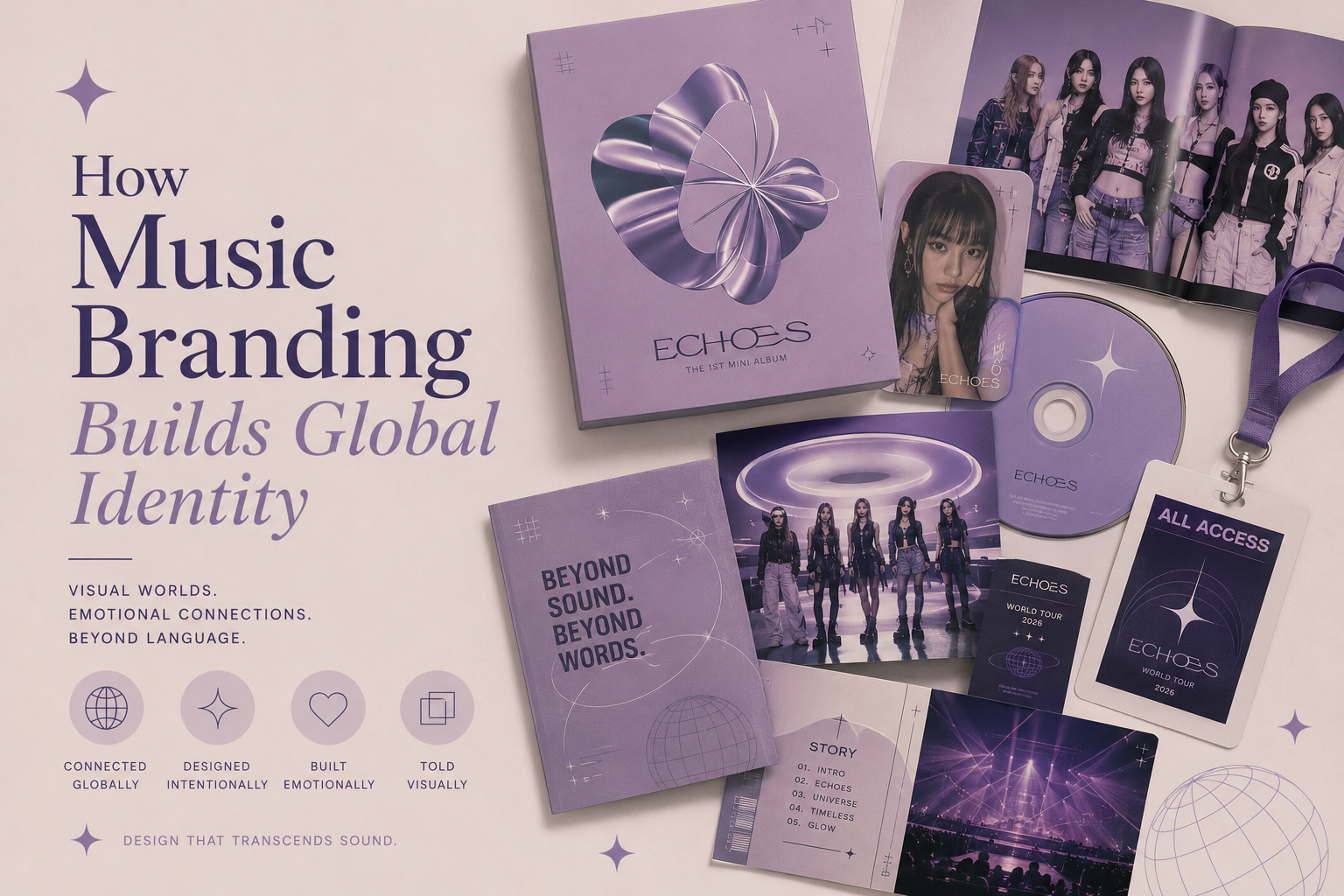
(Image made with AI)
I think there is something kind of magical about watching millions of people scream lyrics in a language they do not speak. K-pop figured out something most industries are still trying to crack. It built a visual world so strong that the language almost does not matter anymore. The music is important, obviously. But the design? The design is quietly doing all the heavy lifting.
The Album as an Experience
When you pick up a K-pop album, you are not just holding a CD. You are holding an entire experience. Every photocard, every font, every color is doing something on purpose. Tassia Assis wrote about this for AIGA's Eye on Design, talking about how fans across the world collect albums specifically for the design and the unboxing, not just the music. Designers like Hyein Kang and Bohuy Kim build entire visual stories through logos, photo books, and packaging that turn a product into something emotional. That is not just packaging anymore. That is branding doing the work of translation.
Intentional Design
And none of it is accidental. Jiahao Liu's research on NewJeans breaks down how intentional every visual choice is. The retro futuristic music videos. The mixed typography. The collectible album versions. All of it is designed to hit a Generation Z audience that processes the world visually first. The font on the cover is not just a font. It is a feeling. It tells you what world you are walking into before you even press play. NewJeans understood that instinctively, and honestly I think that is what made their design inseparable from their sound.
K-pop did not figure this out overnight though. James Chae and Sang kyu Kim traced the evolution of album cover design all the way back to the 1990s, looking at how cultural and technological shifts shaped the way Korean artists presented themselves. They found that K-pop pulled from African American and Japanese visual traditions, blended them, and then exported that hybrid aesthetic globally. What we see now is the result of decades of visual experimentation. A design language that somehow feels familiar and foreign at the same time no matter where you are.
What really got me though was reading about the actual design process. James Chae interviewed studios like MHTL and Paper Press for It's Nice That, and one concept stood out to me immediately. "Bbong." It is a Korean design philosophy built around emotional maximization through visual exaggeration. That is why K-pop visuals feel so loud and so saturated and so unapologetically extra. It is not random. It is strategy. Make someone feel something before they understand anything, and suddenly language does not matter.
Designing for a Story
As someone sitting at the intersection of film and graphic design, this is the stuff that excites me the most. K-pop proved that visual identity is not just support for the story. It is the story. The album is not merch. The music video is not promo. The concert stage is not decoration. They are all chapters in the same narrative, and when they work together, they build something that goes beyond words entirely.
I think that is the real power of design. Not to decorate. But to communicate without needing to say anything at all.
Hi! I’m Jaelyn, a New Jersey–based graphic designer and filmmaker creating thoughtful work through motion, branding, and visual storytelling.
Passionate about culture, tourism design, and crafting strategic identities that connect people, place, and purpose.
